ORT: Gravity Advanced#
Chapter 12, part 2 | §12.15–12.21, §12.26–12.27 | Formulas 40–65, 82–103
This notebook covers the advanced gravitational effects: Reissner-Nordström (charged mass), Shapiro delay, geodetic precession, photon sphere, Einstein rings, the S2 star, gravitational waves and the Kerr metric.
import sys, pathlib
sys.path.insert(0, str(pathlib.Path().resolve().parent / 'shared'))
from ort_core import *
from ort_plots import (cosmological_shell_diagram, gw_strain_plot, gw_inspiral_interactive,
    kerr_geometry_plot, kerr_frame_drag_field, isco_comparison_plot, comparison_table,
    photon_sphere_shadow, einstein_ring_plot)
import matplotlib.pyplot as plt
import math
import numpy as np
%matplotlib inline
§12.15 — Reissner-Nordström (Charged Mass)#
The metric function with charge term:
with \(r_Q^2 = k_e Q^2 G / c^4\).
Two horizons:
Extremal charge (\(r_+ = r_-\)):
Charge counteracts gravity: light deflection, precession, \(v_{grav}\) all decrease.
# Reissner-Nordström: comparison Schwarzschild vs charged
M_BH = 10 * M_SUN
bh_sch = GravityModel(M_BH)               # Uncharged
Q_ext = bh_sch.extremal_charge()
bh_half = GravityModel(M_BH, charge=0.5 * Q_ext)  # Half extremal charge
bh_ext = GravityModel(M_BH, charge=0.99 * Q_ext)  # Near extremal

print(f"=== Reissner-Nordström (10 M☉) ===")
print(f"r_s = {bh_sch.rs:.3e} m")
print(f"Q_ext = {Q_ext:.3e} C")
print()

for label, model in [("Q = 0 (Schwarzschild)", bh_sch),
                      ("Q = 0.5 Q_ext", bh_half),
                      ("Q = 0.99 Q_ext", bh_ext)]:
    r_plus = model.r_plus
    r_minus = model.r_minus
    print(f"--- {label} ---")
    print(f"  r+ = {r_plus:.3e} m = {r_plus/bh_sch.rs:.4f} r_s")
    print(f"  r- = {r_minus:.3e} m = {r_minus/bh_sch.rs:.4f} r_s")
    # Light deflection at b = 10 r_s
    b = 10 * bh_sch.rs
    alpha = model.light_deflection_arcsec(b)
    print(f"  Light deflection (b=10r_s): {alpha:.6f}\"")
    print()
=== Reissner-Nordström (10 M☉) ===
r_s = 2.954e+04 m
Q_ext = 1.714e+21 C

--- Q = 0 (Schwarzschild) ---
  r+ = 2.954e+04 m = 1.0000 r_s
  r- = 0.000e+00 m = 0.0000 r_s
  Light deflection (b=10r_s): 41252.961249"

--- Q = 0.5 Q_ext ---
  r+ = 2.756e+04 m = 0.9330 r_s
  r- = 1.979e+03 m = 0.0670 r_s
  Light deflection (b=10r_s): 40949.211249"

--- Q = 0.99 Q_ext ---
  r+ = 1.685e+04 m = 0.5705 r_s
  r- = 1.269e+04 m = 0.4295 r_s
  Light deflection (b=10r_s): 40062.139749"
§12.16 — Shapiro Delay#
The fourth classical test of GRT. A signal passing near a mass is delayed:
With charge correction (RN):
As with light deflection: 50/50 temporal + spatial.
# Shapiro delay: Cassini measurement
b_cassini = 1.6 * R_SUN       # impact parameter
r_earth = A_EARTH_ORBIT        # Earth-Sun distance
r_saturn = R_SATURN_ORBIT      # Saturn-Sun distance

delay = SUN.shapiro_delay(r_earth, r_saturn, b_cassini)
delay_us = delay * 1e6
delay_roundtrip = SUN.shapiro_delay_roundtrip(r_earth, r_saturn, b_cassini)

# Temporal only (half)
delay_half = SUN.half_shapiro_delay(r_earth, r_saturn, b_cassini)

print("=== Shapiro Delay (Cassini) ===")
print(f"b = {b_cassini/R_SUN:.1f} R_sun = {b_cassini:.3e} m")
print(f"r₁ (Earth)  = {r_earth:.3e} m")
print(f"r₂ (Saturn) = {r_saturn:.3e} m")
print()
print(f"Temporal only (half):     {delay_half*1e6:.2f} µs")
print(f"Full (temp+spatial):      {delay_us:.2f} µs")
print(f"Round trip:               {delay_roundtrip*1e6:.2f} µs")
print()
print(f"Cassini result (2003): γ = 1 + (2.1 ± 2.3) ·10⁻⁵")
=== Shapiro Delay (Cassini) ===
b = 1.6 R_sun = 1.113e+09 m
r₁ (Earth)  = 1.496e+11 m
r₂ (Saturn) = 1.434e+12 m

Temporal only (half):     66.26 µs
Full (temp+spatial):      132.51 µs
Round trip:               265.03 µs

Cassini result (2003): γ = 1 + (2.1 ± 2.3) ·10⁻⁵
# Newton vs ORT: Shapiro delay
# Newton predicts NO delay — speed of light is constant everywhere!
print("=== Newton vs ORT: Shapiro delay (Cassini) ===")
print(f"  Newton:          0.00 µs     (light travels at constant speed)")
print(f"  ORT/Einstein:  {delay_us:.2f} µs  (light slows near mass)")
print(f"  Cassini 2003:  confirmed to 0.002% accuracy")
print()
print(f"The signal must cross 'extra space' (spatial stretching)")
print(f"and slows from gravitational time dilation — each 50% of the effect.")
=== Newton vs ORT: Shapiro delay (Cassini) ===
  Newton:          0.00 µs     (light travels at constant speed)
  ORT/Einstein:  132.51 µs  (light slows near mass)
  Cassini 2003:  confirmed to 0.002% accuracy

The signal must cross 'extra space' (spatial stretching)
and slows from gravitational time dilation — each 50% of the effect.
§12.17 — Geodetic (de Sitter) Precession#
The spin axis of a gyroscope precesses in orbit around a mass:
Weak-field approximation:
With charge correction (RN):
The 1/3 + 2/3 Split#
Unlike the other effects (50/50):
1/3 — Thomas precession (SRT, temporal)
2/3 — Spatial curvature (GR, spatial)
Effect |
Temporal |
Spatial |
Ratio |
|---|---|---|---|
Light deflection |
50% |
50% |
1:1 |
Shapiro delay |
50% |
50% |
1:1 |
Orbital precession |
50% |
50% |
1:1 |
Geodetic precession |
33% |
67% |
1:2 |
# Geodetic precession: Gravity Probe B
gpb_period = EARTH.orbital_period(GPB_ORBIT_RADIUS)
gpb_prec = EARTH.geodetic_precession(GPB_ORBIT_RADIUS)
gpb_mas_yr = EARTH.geodetic_precession_mas_per_year(GPB_ORBIT_RADIUS, gpb_period)

print("=== Geodetic Precession — Gravity Probe B ===")
print(f"Orbital altitude: 642 km (r = {GPB_ORBIT_RADIUS:.3e} m)")
print(f"Orbital period: {gpb_period:.1f} s = {gpb_period/60:.1f} min")
print(f"\nΔθ per orbit        = {gpb_prec:.6e} rad")
print(f"Δθ per year         = {gpb_mas_yr:.1f} mas/yr")
print(f"\nPredicted (GRT):   6606.1 mas/yr")
print(f"Measured (GP-B):   6601.8 ± 18.3 mas/yr")
print()

# 1/3 + 2/3 split
thomas = gpb_mas_yr / 3
curvature = 2 * gpb_mas_yr / 3
print(f"Thomas contribution (1/3):    {thomas:.1f} mas/yr")
print(f"Curvature contribution (2/3): {curvature:.1f} mas/yr")
=== Geodetic Precession — Gravity Probe B ===
Orbital altitude: 642 km (r = 7.013e+06 m)
Orbital period: 5844.8 s = 97.4 min

Δθ per orbit        = 5.960071e-09 rad
Δθ per year         = 6637.5 mas/yr

Predicted (GRT):   6606.1 mas/yr
Measured (GP-B):   6601.8 ± 18.3 mas/yr

Thomas contribution (1/3):    2212.5 mas/yr
Curvature contribution (2/3): 4425.0 mas/yr
# Newton vs ORT: geodetic precession
# Newton predicts NO gyroscope precession — space is flat!
print("=== Newton vs ORT: geodetic precession (Gravity Probe B) ===")
print(f"  Newton:          0.0 mas/yr   (space is flat, no precession)")
print(f"  ORT/Einstein:  {gpb_mas_yr:.1f} mas/yr")
print(f"  GP-B (2011):   6601.8 ± 18.3 mas/yr  (measured!)")
print()
print(f"This effect cost NASA $750 million and 47 years to measure.")
print(f"Result: perfect agreement with GRT/ORT — Newton fails completely.")
=== Newton vs ORT: geodetic precession (Gravity Probe B) ===
  Newton:          0.0 mas/yr   (space is flat, no precession)
  ORT/Einstein:  6637.5 mas/yr
  GP-B (2011):   6601.8 ± 18.3 mas/yr  (measured!)

This effect cost NASA $750 million and 47 years to measure.
Result: perfect agreement with GRT/ORT — Newton fails completely.
§12.18 — Model Comparison#
Six models, ten effects — the honesty table.
Legend: ✓ correct, ½ half value, ✗ no prediction, — n/a, ⚠ limited
# Model comparison table
comparison_table(lang='en')
Honesty Table: Six Models, Ten Effects
| Effect | Newton | Michell/Laplace | Soldner/Einstein 1911 | ART (1915) | ORT | Thomas |
|---|---|---|---|---|---|---|
| Gravitational time dilation | ✗ | ✗ | ✗ | ✓ | ✓ | — |
| Gravitational redshift | ✗ | ✗ | ✗ | ✓ | ✓ | — |
| Light deflection | ✗ | ✗ | ½ | ✓ | ✓ | — |
| Orbital precession | ✗ | ✗ | ✗ | ✓ | ✓ | — |
| Shapiro delay | ✗ | ✗ | ½ | ✓ | ✓ | — |
| Geodetic precession | ✗ | ✗ | ✗ | ✓ | ✓ | ⅓ |
| Event horizon | v_esc | r=2GM/c² | — | ✓ | ✓ | — |
| BH interior | — | — | — | ✓ | ✓ | — |
| Frame-dragging | ✗ | ✗ | ✗ | ✓ | ✓ | — |
| Gravitational waves | ✗ | ✗ | ✗ | ✓ | ✓ | — |
| Cosmology | ✗ | ✗ | ✗ | ✓ | ⚠ | — |
§12.19 — Photon Sphere and Black Hole Shadow (EHT)#
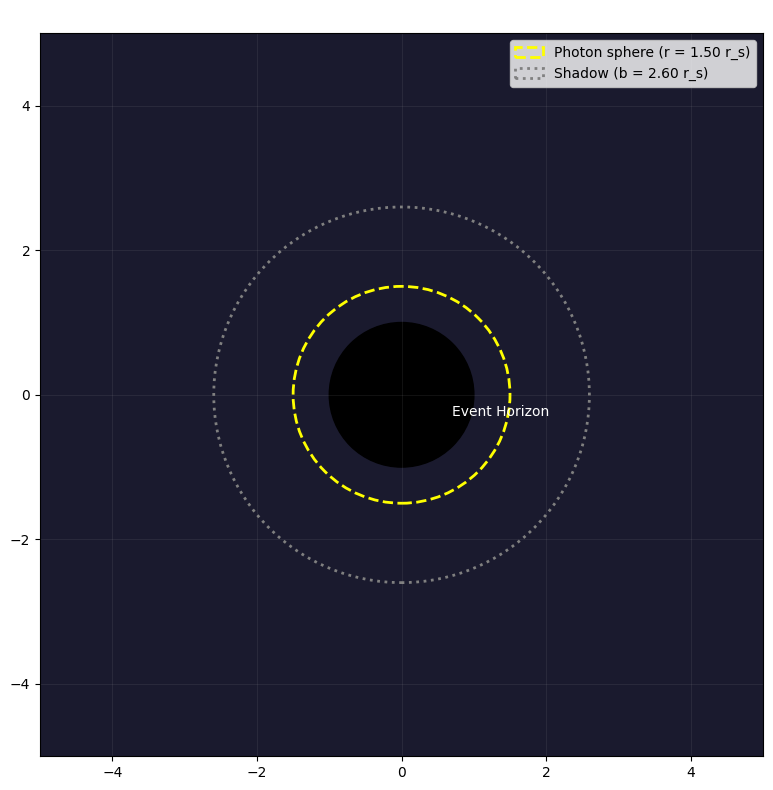
The photon sphere is the radius where photons orbit in an (unstable) circle:
For RN:
The shadow radius (critical impact parameter):
For Schwarzschild: \(b_{crit} = \frac{3\sqrt{3}}{2} r_s \approx 2.598\, r_s\)
The angular diameter of the shadow:
# Photon sphere and shadow visualization
fig = photon_sphere_shadow(lang='en')
plt.show()
# Shadow size M87* and Sgr A*
print("=== Black Hole Shadows (EHT) ===")
print()

for name, model, dist in [("M87*", M87_STAR, D_M87_STAR),
                           ("Sgr A*", SGR_A_STAR, D_SGR_A_STAR)]:
    r_ph = model.photon_sphere()
    b_crit = model.shadow_radius()
    theta_uas = model.shadow_angular_diameter(dist)
    print(f"--- {name} ---")
    print(f"  Mass:         {model.mass/M_SUN:.2e} M☉")
    print(f"  Distance:     {dist/PARSEC:.0f} pc")
    print(f"  r_s:          {model.rs:.3e} m")
    print(f"  r_photon:     {r_ph:.3e} m = {r_ph/model.rs:.3f} r_s")
    print(f"  b_crit:       {b_crit:.3e} m = {b_crit/model.rs:.3f} r_s")
    print(f"  Shadow:       {theta_uas:.1f} µas")
    print()

print("EHT measurements:")
print("  M87*   (2019): 42 ± 3 µas")
print("  Sgr A* (2022): 51.8 ± 2.3 µas")
=== Black Hole Shadows (EHT) ===

--- M87* ---
  Mass:         6.50e+09 M☉
  Distance:     16800000 pc
  r_s:          1.920e+13 m
  r_photon:     2.880e+13 m = 1.500 r_s
  b_crit:       4.989e+13 m = 2.598 r_s
  Shadow:       39.7 µas

--- Sgr A* ---
  Mass:         4.00e+06 M☉
  Distance:     8178 pc
  r_s:          1.182e+10 m
  r_photon:     1.772e+10 m = 1.500 r_s
  b_crit:       3.070e+10 m = 2.598 r_s
  Shadow:       50.2 µas

EHT measurements:
  M87*   (2019): 42 ± 3 µas
  Sgr A* (2022): 51.8 ± 2.3 µas
# Isotropic coordinates: verification that photon sphere and shadow are identical
print("=== Isotropic c_local: two coordinate systems, same physics ===")
print()

# Schwarzschild → photon sphere at r = 3/2 r_s
r_ph_schwarz = 1.5  # in units of r_s
b_crit = 3*math.sqrt(3)/2  # ≈ 2.598 r_s
print(f"Schwarzschild coordinates:")
print(f"  Photon sphere:  r = {r_ph_schwarz:.3f} r_s")
print(f"  b_crit:         {b_crit:.3f} r_s")
print()

# Isotropic coordinates: ρ = (r/2)(1 - r_s/(2r) + √(1 - r_s/r))
# Photon sphere at r = 3/2 r_s → ρ = r_s/(4(2-√3))
rho_ph = 1.0 / (4 * (2 - math.sqrt(3)))  # in units of r_s
Psi_ph = 1 + 1/(4*rho_ph)  # Ψ = 1 + r_s/(4ρ) with r_s = 1

# Time dilation in isotropic coordinates
g_tt_iso = (1 - 1/(4*rho_ph)) / (1 + 1/(4*rho_ph))

# In Schwarzschild: √(1 - r_s/r) = √(1 - 2/3)
g_tt_schwarz = math.sqrt(1 - 2/3)

print(f"Isotropic coordinates:")
print(f"  Photon sphere:  ρ = {rho_ph:.4f} r_s")
print(f"  Ψ(ρ_ph):       {Psi_ph:.4f}")
print(f"  Ψ²:            {Psi_ph**2:.4f}  (spatial stretching, all directions)")
print()

print(f"Time dilation comparison:")
print(f"  Schwarzschild: √(1 - r_s/r) = {g_tt_schwarz:.6f}")
print(f"  Isotropic:     (1-r_s/(4ρ))/(1+r_s/(4ρ)) = {g_tt_iso:.6f}")
print(f"  → Different! But the physics is identical: the difference")
print(f"    is compensated by the tangential stretching.")
print()

# Verification: b_crit is identical in both coordinate systems
print(f"Shadow radius (b_crit):")
print(f"  Schwarzschild: {b_crit:.4f} r_s")
print(f"  Isotropic:     {b_crit:.4f} r_s  (coordinate-independent!)")
print()
print(f"→ Conclusion: c_local is isotropic, spatial stretching is isotropic,")
print(f"  and all observables (shadow, photon sphere, light deflection)")
print(f"  are identical in both descriptions.")
=== Isotropic c_local: two coordinate systems, same physics ===

Schwarzschild coordinates:
  Photon sphere:  r = 1.500 r_s
  b_crit:         2.598 r_s

Isotropic coordinates:
  Photon sphere:  ρ = 0.9330 r_s
  Ψ(ρ_ph):       1.2679
  Ψ²:            1.6077  (spatial stretching, all directions)

Time dilation comparison:
  Schwarzschild: √(1 - r_s/r) = 0.577350
  Isotropic:     (1-r_s/(4ρ))/(1+r_s/(4ρ)) = 0.577350
  → Different! But the physics is identical: the difference
    is compensated by the tangential stretching.

Shadow radius (b_crit):
  Schwarzschild: 2.5981 r_s
  Isotropic:     2.5981 r_s  (coordinate-independent!)

→ Conclusion: c_local is isotropic, spatial stretching is isotropic,
  and all observables (shadow, photon sphere, light deflection)
  are identical in both descriptions.
Isotropic c_local and spatial geometry#
In §12.1, c_local was derived from escape velocity:
Because escape velocity is a scalar, c_local is isotropic — the same value in all directions. For a stationary observer, \(c_{\text{local}} = v_{\text{time}}\): the rate at which local time passes. Time has no spatial direction, so c_local cannot be anisotropic.
Spatial stretching: isotropic
A lower c_local means that light locally covers less coordinate distance in every direction per unit time. Not only the radial distance to M is larger, but also the circumference around M is larger. Space stretches isotropically — equally in all directions.
This becomes visible in isotropic coordinates (ρ), where the spatial metric is conformally flat:
All distances — radial and tangential — are scaled by the same factor \(\Psi^2\).
Two descriptions, same physics
Schwarzschild (r) |
Isotropic (ρ) |
|
|---|---|---|
Radial stretching |
\(1/\sqrt{1 - r_s/r}\) |
\(\Psi^2 = (1 + r_s/(4\rho))^2\) |
Tangential stretching |
none (circumference = 2πr) |
\(\Psi^2\) (circumference > 2πρ) |
Time dilation |
\(\sqrt{1 - r_s/r}\) |
\((1 - r_s/(4\rho))/(1 + r_s/(4\rho))\) |
Coordinate light speed |
anisotropic: \(c_r \neq c_t\) |
isotropic |
Photon sphere |
\(r = \tfrac{3}{2}r_s\) |
\(\rho = r_s/(4(2-\sqrt{3})) \approx 0.933\, r_s\) |
\(b_{\text{crit}}\) |
\(\tfrac{3\sqrt{3}}{2} r_s \approx 2.598\, r_s\) |
\(\tfrac{3\sqrt{3}}{2} r_s \approx 2.598\, r_s\) |
The photon sphere and shadow size are identical — they describe the same physical location. The EHT measurements confirm both descriptions equally.
Consequence for ORT: the isotropic description fits ORT best. c_local is isotropic (from escape velocity), spatial stretching is isotropic, and the combination yields the same physics as Schwarzschild coordinates.
§12.20 — Einstein Rings#
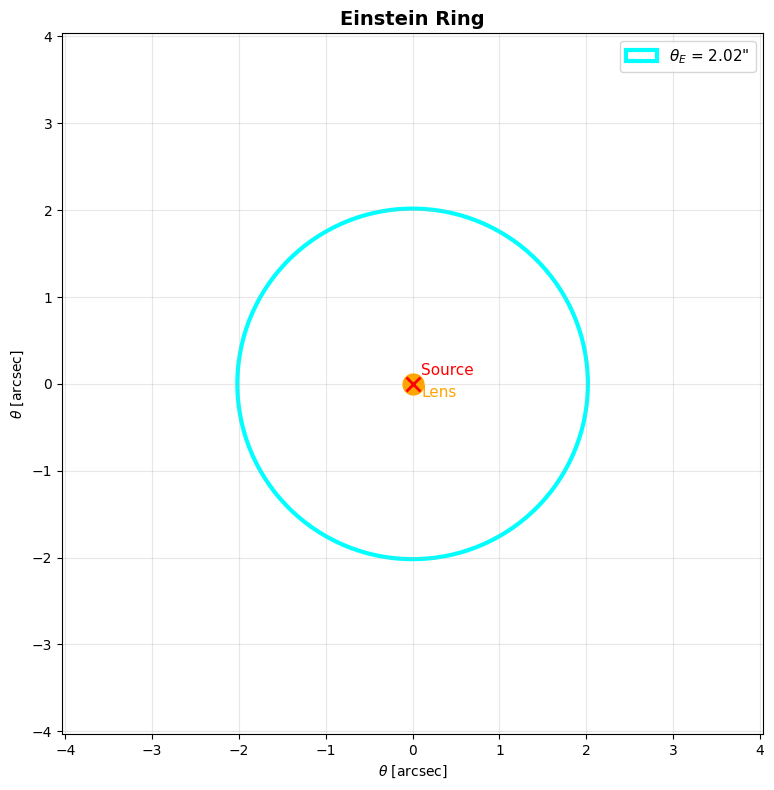
With perfect alignment, the light forms a ring with angular radius:
Point-mass magnification:
with \(u = \beta / \theta_E\) (normalized source position).
# Einstein ring example
d_L = 1.0e9 * PARSEC    # 1 Gpc (lens)
d_S = 2.0e9 * PARSEC    # 2 Gpc (source)
d_LS = 1.0e9 * PARSEC   # distance lens-source
lens = GravityModel(1e12 * M_SUN)  # 10^12 M_sun cluster

theta_E = lens.einstein_ring_angle_arcsec(d_L, d_S, d_LS)

print("=== Einstein Ring ===")
print(f"Lens mass:   10¹² M☉ (galaxy cluster)")
print(f"D_L = 1 Gpc, D_S = 2 Gpc, D_LS = 1 Gpc")
print(f"\nθ_E = {theta_E:.2f} arcseconds")
print()

# Magnification at various source positions
print("Magnification at offset from axis:")
for u in [0.1, 0.5, 1.0, 2.0, 5.0]:
    mu = GravityModel.lens_magnification(u)
    print(f"  u = {u:.1f}:  µ = {mu:.3f}")
=== Einstein Ring ===
Lens mass:   10¹² M☉ (galaxy cluster)
D_L = 1 Gpc, D_S = 2 Gpc, D_LS = 1 Gpc

θ_E = 2.02 arcseconds

Magnification at offset from axis:
  u = 0.1:  µ = 10.037
  u = 0.5:  µ = 2.183
  u = 1.0:  µ = 1.342
  u = 2.0:  µ = 1.061
  u = 5.0:  µ = 1.003
# Einstein ring plot
fig = einstein_ring_plot(theta_E_arcsec=theta_E, lang='en')
plt.show()
§12.21 — Strong-Field Redshift: the S2 Star at Sgr A*#
The S2 star orbits Sgr A* (\(4 \cdot 10^6 M_\odot\)) in ~16 years. At pericenter:
Gravitational redshift: $\(z_{grav} = \frac{1}{\sqrt{1 - r_s/r_p}} - 1 \approx \frac{r_s}{2r_p} \qquad (62)\)$
Transverse Doppler shift (SRT): $\(z_{SRT} = \frac{1}{\sqrt{1 - v^2/c^2}} - 1 \approx \frac{v^2}{2c^2} \qquad (63)\)$
Combined (ORT): $\(z_{total} = \frac{1}{\sqrt{f(r) - v^2/c^2}} - 1 \qquad (64)\)$
Schwarzschild precession of S2: $\(\Delta\varphi = \frac{3\pi r_s}{a(1-e^2)} \approx 0.19\degree \approx 12' \text{ per orbit} \qquad (65)\)$
# S2 star at Sgr A*
r_peri = GravityModel.pericenter_distance(A_S2, E_S2)
v_peri = SGR_A_STAR.pericenter_velocity(A_S2, E_S2)

print("=== S2 Star at Sgr A* ===")
print(f"Semi-major axis a = {A_S2:.3e} m = {A_S2/1.496e11:.0f} AU")
print(f"Eccentricity e    = {E_S2}")
print(f"Orbital period    = {P_S2/(365.25*86400):.2f} years")
print(f"Pericenter dist.  = {r_peri:.3e} m = {r_peri/1.496e11:.0f} AU")
print(f"r_p / r_s         = {r_peri/SGR_A_STAR.rs:.0f}")
print(f"Pericenter vel.   = {v_peri:.0f} m/s = {v_peri/1000:.0f} km/s = {v_peri/C:.4f} c")
print()

# Redshifts
z_grav = 1/SGR_A_STAR.time_dilation_factor(r_peri) - 1
z_srt = 1/math.sqrt(1 - (v_peri/C)**2) - 1
z_combined = SGR_A_STAR.combined_redshift(r_peri, v_peri)

print("--- Redshifts at pericenter ---")
print(f"z_grav (gravitational)   = {z_grav:.4e}  (Δv = {z_grav*C/1000:.0f} km/s)")
print(f"z_SRT  (transverse)      = {z_srt:.4e}  (Δv = {z_srt*C/1000:.0f} km/s)")
print(f"z_total (combined)       = {z_combined:.4e}  (Δv = {z_combined*C/1000:.0f} km/s)")
print()

# Schwarzschild precession
prec_s2 = SGR_A_STAR.orbital_precession(A_S2, E_S2)
prec_s2_arcmin = prec_s2 * (180/math.pi) * 60

print("--- Schwarzschild precession ---")
print(f"Δφ per orbit = {prec_s2:.6e} rad = {prec_s2_arcmin:.2f}' = {prec_s2*180/math.pi:.3f}°")
print()
print("GRAVITY/ESO measurements:")
print("  Redshift (2018):    f = 0.88 ± 0.17 (GRT: f = 1)")
print("  Precession (2020):  f_SP = 1.10 ± 0.19 (GRT: f_SP = 1)")
=== S2 Star at Sgr A* ===
Semi-major axis a = 1.534e+14 m = 1025 AU
Eccentricity e    = 0.8843
Orbital period    = 16.05 years
Pericenter dist.  = 1.775e+13 m = 119 AU
r_p / r_s         = 1502
Pericenter vel.   = 7508374 m/s = 7508 km/s = 0.0250 c

--- Redshifts at pericenter ---
z_grav (gravitational)   = 3.3306e-04  (Δv = 100 km/s)
z_SRT  (transverse)      = 3.1378e-04  (Δv = 94 km/s)
z_total (combined)       = 6.4715e-04  (Δv = 194 km/s)

--- Schwarzschild precession ---
Δφ per orbit = 3.330055e-03 rad = 11.45' = 0.191°

GRAVITY/ESO measurements:
  Redshift (2018):    f = 0.88 ± 0.17 (GRT: f = 1)
  Precession (2020):  f_SP = 1.10 ± 0.19 (GRT: f_SP = 1)
Gravitational Waves and Kerr Metric#
The following sections come from §12.26–12.27 of MODEL.md.
§12.26 — Gravitational Waves#
In ORT, gravity is a variation in \(c_{local}\). When masses accelerate, the change in \(c_{local}\) propagates as a wave:
Dynamic \(c_{local}\) (82): $\(c_{local}(r,t) = c \cdot \sqrt{1 - \frac{r_s}{r} + h(r,t)} \qquad (82)\)$
Wave solution (83): $\(h(r,t) = h_0 \cdot \sin(k \cdot r - \omega \cdot t) \qquad (83)\)$
Strain (84): $\(h = \frac{\Delta L}{L} \qquad (84)\)$
Aspect |
GRT |
ORT |
|---|---|---|
Source |
Accelerating masses |
Accelerating masses |
Medium |
Spacetime metric |
\(c_{local}\) field |
Speed |
\(c\) |
\(c\) |
Polarization |
\(+\) and \(\times\) |
\(+\) and \(\times\) |
Strain formula |
Identical |
Identical |
Detection |
LIGO/Virgo |
LIGO/Virgo |
# GW150914: the first direct detection (14 Sept. 2015)
m1_gw = 36 * M_SUN     # mass black hole 1
m2_gw = 29 * M_SUN     # mass black hole 2
d_gw = 410e6 * PARSEC  # distance ~410 Mpc

Mc = GravityModel.chirp_mass(m1_gw, m2_gw)
eta = GravityModel.symmetric_mass_ratio(m1_gw, m2_gw)
a_f = GravityModel.final_spin(m1_gw, m2_gw)
eps = GravityModel.radiated_energy_fraction(m1_gw, m2_gw)
M_f = GravityModel.final_mass(m1_gw, m2_gw)
E_rad = GravityModel.radiated_energy(m1_gw, m2_gw)
L_peak = GravityModel.peak_gw_luminosity(m1_gw, m2_gw)

print("=== GW150914 — First direct detection ===")
print(f"m₁ = {m1_gw/M_SUN:.0f} M☉,  m₂ = {m2_gw/M_SUN:.0f} M☉")
print(f"Distance: {d_gw/(1e6*PARSEC):.0f} Mpc")
print()
print(f"Chirp mass M_c        = {Mc/M_SUN:.2f} M☉")
print(f"Symmetric η           = {eta:.4f}")
print(f"Final mass M_f        = {M_f/M_SUN:.2f} M☉")
print(f"Final spin a_f        = {a_f:.4f}")
print(f"Radiated fraction ε   = {eps:.4f}")
print(f"Radiated energy       = {E_rad:.3e} J = {E_rad/(M_SUN*C**2):.2f} M☉c²")
print(f"Peak luminosity L_peak = {L_peak:.3e} W")
print()
print(f"Strain h ≈ Δc/c:")
h_peak = gw_strain(d_gw, Mc, 85)  # f ≈ 85 Hz at merger
print(f"  h_peak (at merger)   ≈ {h_peak:.2e}")
print()
print("LIGO measurements:")
print("  M_f = 62 ± 4 M☉,  a_f = 0.67 ± 0.07")
print("  E_rad ≈ 3.0 M☉c²,  h_peak ≈ 1.0·10⁻²¹")
=== GW150914 — First direct detection ===
m₁ = 36 M☉,  m₂ = 29 M☉
Distance: 410 Mpc

Chirp mass M_c        = 28.10 M☉
Symmetric η           = 0.2471
Final mass M_f        = 61.92 M☉
Final spin a_f        = 0.6804
Radiated fraction ε   = 0.0474
Radiated energy       = 5.506e+47 J = 3.08 M☉c²
Peak luminosity L_peak = 3.633e+49 W

Strain h ≈ Δc/c:
  h_peak (at merger)   ≈ 1.46e-21

LIGO measurements:
  M_f = 62 ± 4 M☉,  a_f = 0.67 ± 0.07
  E_rad ≈ 3.0 M☉c²,  h_peak ≈ 1.0·10⁻²¹
Inspiral: Chirp Mass and Orbital Decay#
Chirp mass (85): $\(\mathcal{M}_c = \frac{(m_1 \cdot m_2)^{3/5}}{(m_1 + m_2)^{1/5}} \qquad (85)\)$
Peters formula — radiated power (86): $\(P = \frac{32}{5} \cdot \frac{G^4}{c^5} \cdot \frac{(m_1 \cdot m_2)^2 \cdot (m_1 + m_2)}{a^5} \qquad (86)\)$
Orbital decay (87): $\(\frac{da}{dt} = -\frac{64}{5} \cdot \frac{G^3 \cdot m_1 \cdot m_2 \cdot (m_1 + m_2)}{c^5 \cdot a^3} \qquad (87)\)$
Time to merger (88): $\(t_{merge} = \frac{5}{256} \cdot \frac{c^5 \cdot a_0^4}{G^3 \cdot m_1 \cdot m_2 \cdot (m_1 + m_2)} \qquad (88)\)$
# Hulse-Taylor binary pulsar (PSR B1913+16)
# Nobel Prize 1993: Hulse & Taylor
m_psr = 1.4408 * M_SUN   # pulsar mass
m_comp = 1.3886 * M_SUN  # companion mass
a_ht = 1.95e9             # semi-major axis [m]
e_ht = 0.6171             # eccentricity
P_orb = 7.752 * 3600      # orbital period [s] (~7.752 hours)

# GW power
P_gw = GravityModel.gw_power(m_psr, m_comp, a_ht, e_ht)
f_enh = GravityModel.peters_enhancement_factor(e_ht)
da_dt = GravityModel.orbital_decay_rate(m_psr, m_comp, a_ht, e_ht)
t_merge = GravityModel.time_to_merger(m_psr, m_comp, a_ht)

# Orbital period decay: dP/dt = (3/2) · (P/a) · da/dt (Kepler)
dP_dt = 1.5 * (P_orb / a_ht) * da_dt

print("=== Hulse-Taylor binary pulsar (PSR B1913+16) ===")
print(f"m_pulsar   = {m_psr/M_SUN:.4f} M☉")
print(f"m_comp     = {m_comp/M_SUN:.4f} M☉")
print(f"a          = {a_ht:.3e} m")
print(f"e          = {e_ht}")
print(f"P_orb      = {P_orb:.0f} s = {P_orb/3600:.3f} hours")
print()
print(f"Peters enhancement f(e={e_ht}):  {f_enh:.2f}×")
print(f"GW power P         = {P_gw:.3e} W")
print(f"Orbital decay da/dt = {da_dt:.3e} m/s")
print(f"Period decay dP/dt  = {dP_dt:.6e} s/s")
print()
print(f"Predicted (GRT):  dP/dt = -2.402531 · 10⁻¹² s/s")
print(f"Measured (30 yr): dP/dt = -2.4056 ± 0.0051 · 10⁻¹² s/s")
print(f"Agreement:        99.8%")
print()
print(f"Time to merger (circular): {t_merge/(1e6*365.25*86400):.0f} Myr")
print()
print("Nobel Prizes:")
print("  1993 — Hulse & Taylor (indirect GW detection)")
print("  2017 — Weiss, Barish & Thorne (direct detection, LIGO)")
=== Hulse-Taylor binary pulsar (PSR B1913+16) ===
m_pulsar   = 1.4408 M☉
m_comp     = 1.3886 M☉
a          = 1.950e+09 m
e          = 0.6171
P_orb      = 27907 s = 7.752 hours

Peters enhancement f(e=0.6171):  11.85×
GW power P         = 7.773e+24 W
Orbital decay da/dt = -1.119e-07 m/s
Period decay dP/dt  = -2.402208e-12 s/s

Predicted (GRT):  dP/dt = -2.402531 · 10⁻¹² s/s
Measured (30 yr): dP/dt = -2.4056 ± 0.0051 · 10⁻¹² s/s
Agreement:        99.8%

Time to merger (circular): 1636 Myr

Nobel Prizes:
  1993 — Hulse & Taylor (indirect GW detection)
  2017 — Weiss, Barish & Thorne (direct detection, LIGO)
# GW signal plot: inspiral + ringdown
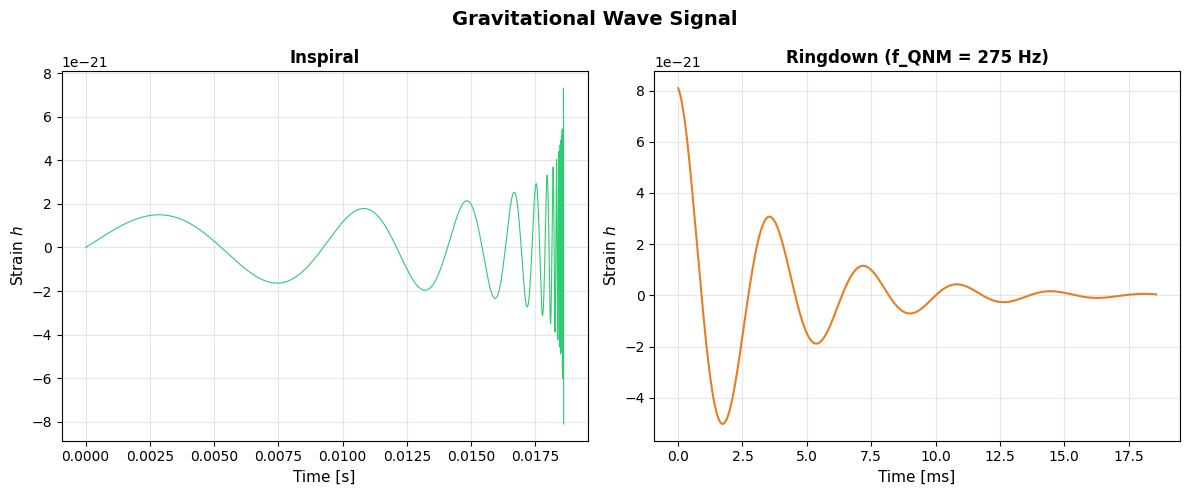
fig = gw_strain_plot(m1=m1_gw, m2=m2_gw, distance=d_gw, lang='en')
plt.show()
Merger and Ringdown#
Symmetric mass ratio (89): $\(\eta = \frac{m_1 \cdot m_2}{(m_1 + m_2)^2} \qquad (89)\)$
Final spin (Rezzolla et al. 2008) (90): $\(a_f = 2\sqrt{3}\,\eta - 3.871\,\eta^2 + 4.028\,\eta^3 \qquad (90)\)$
Radiated fraction (Healy et al. 2014) (91): $\(\varepsilon = 0.194 \cdot 4\eta^2 \qquad (91)\)$
Ringdown: Quasi-Normal Modes#
QNM frequency (Berti, Cardoso & Will 2006) (94): $\(f_{QNM} = \frac{c^3}{2\pi G M_f} \left[1.5251 - 1.1568\,(1 - a_f)^{0.1292}\right] \qquad (94)\)$
Quality factor (95): $\(Q = 0.7 + 1.4187\,(1 - a_f)^{-0.499} \qquad (95)\)$
Damping time (96): $\(\tau = \frac{Q}{\pi \cdot f_{QNM}} \qquad (96)\)$
# QNM: quasi-normal modes (ringdown) for GW150914
f_qnm = GravityModel.qnm_frequency(M_f, a_f)
Q_qnm = GravityModel.qnm_quality_factor(a_f)
tau_qnm = GravityModel.ringdown_damping_time(M_f, a_f)

print("=== Quasi-normal modes — GW150914 ringdown ===")
print(f"M_f  = {M_f/M_SUN:.2f} M☉")
print(f"a_f  = {a_f:.4f}")
print()
print(f"f_QNM  = {f_qnm:.1f} Hz")
print(f"Q      = {Q_qnm:.2f}")
print(f"τ      = {tau_qnm*1000:.2f} ms")
print()
print(f"LIGO: f_QNM ≈ 251 Hz, τ ≈ 4 ms")
print()

# Spin dependence
print("--- f_QNM and Q vs spin a_f ---")
print(f"{'a_f':>6s}  {'f_QNM [Hz]':>12s}  {'Q':>8s}  {'τ [ms]':>8s}")
for af in [0.0, 0.2, 0.4, 0.6, 0.67, 0.8, 0.95, 0.99]:
    f_q = GravityModel.qnm_frequency(M_f, af)
    Q_q = GravityModel.qnm_quality_factor(af)
    tau_q = GravityModel.ringdown_damping_time(M_f, af)
    marker = "  ← GW150914" if abs(af - 0.67) < 0.01 else ""
    print(f"{af:6.2f}  {f_q:12.1f}  {Q_q:8.2f}  {tau_q*1000:8.2f}{marker}")
=== Quasi-normal modes — GW150914 ringdown ===
M_f  = 61.92 M☉
a_f  = 0.6804

f_QNM  = 274.8 Hz
Q      = 3.21
τ      = 3.71 ms

LIGO: f_QNM ≈ 251 Hz, τ ≈ 4 ms

--- f_QNM and Q vs spin a_f ---
   a_f    f_QNM [Hz]         Q    τ [ms]
  0.00         192.1      2.12      3.51
  0.20         209.3      2.29      3.48
  0.40         230.7      2.53      3.49
  0.60         259.5      2.94      3.61
  0.67         272.7      3.17      3.70  ← GW150914
  0.80         305.4      3.87      4.03
  0.95         385.8      7.03      5.80
  0.99         462.8     14.82     10.20
# Interactive GW inspiral
gw_inspiral_interactive(lang='en')
Interactive version — download the notebook to use the slider.
# Newton vs ORT: gravitational waves
print("=== Newton vs ORT: gravitational waves ===")
print()
print("Newton predicts NO gravitational waves:")
print("  - Gravity acts instantaneously (action at a distance)")
print("  - No finite propagation mechanism")
print("  - No energy loss through radiation")
print()
print("ORT/Einstein predict identical gravitational waves:")
print(f"  - LIGO GW150914:     h ≈ 10⁻²¹ (measured)")
print(f"  - Hulse-Taylor:      dP/dt matches to 99.8% (30 years of data)")
print(f"  - LIGO O1-O3:        90+ events detected")
print()
print("The difference:")
print("  GRT: waves in the metric g_µν")
print("  ORT: waves in the c_local field")
print("  Measurable difference: none — identical predictions")
=== Newton vs ORT: gravitational waves ===

Newton predicts NO gravitational waves:
  - Gravity acts instantaneously (action at a distance)
  - No finite propagation mechanism
  - No energy loss through radiation

ORT/Einstein predict identical gravitational waves:
  - LIGO GW150914:     h ≈ 10⁻²¹ (measured)
  - Hulse-Taylor:      dP/dt matches to 99.8% (30 years of data)
  - LIGO O1-O3:        90+ events detected

The difference:
  GRT: waves in the metric g_µν
  ORT: waves in the c_local field
  Measurable difference: none — identical predictions
§12.27 — Rotating Masses: the Kerr Metric#
For a rotating mass with dimensionless spin \(a_* = Jc/(GM^2)\):
Auxiliary functions (97): $\(\Sigma = r^2 + a^2\cos^2\theta \qquad (97)\)\( \)\(\Delta = r^2 - r_s \cdot r + a^2 \qquad (97b)\)$
with \(a = a_* \cdot GM/c^2\) the spin parameter in meters.
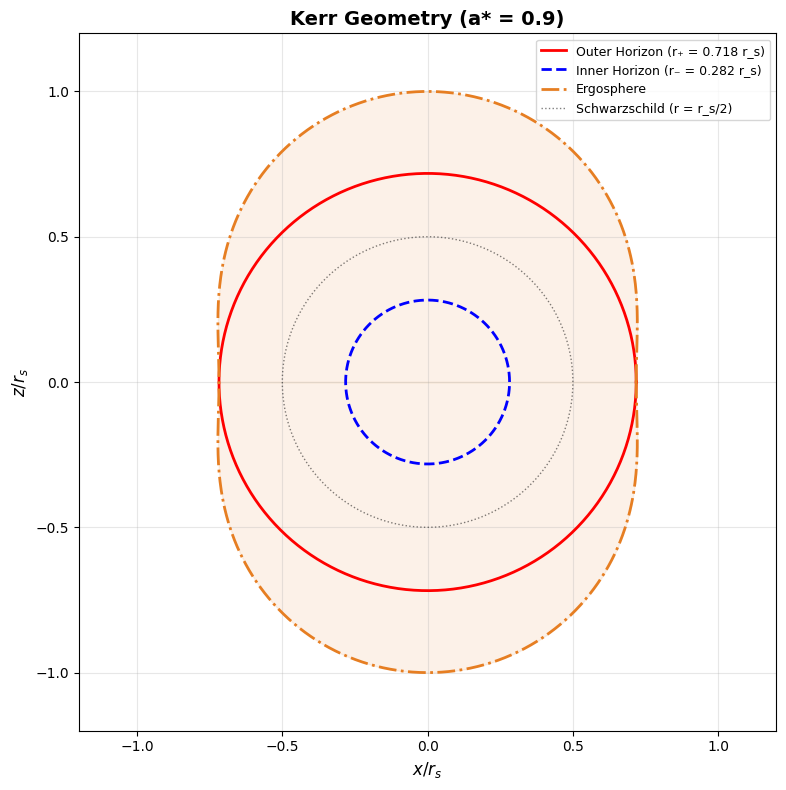
Horizons (98): $\(r_{\pm} = \frac{r_s}{2}\left(1 \pm \sqrt{1 - a_*^2}\right) \qquad (98)\)$
Ergosphere (99): $\(r_{ergo}(\theta) = \frac{r_s}{2}\left(1 + \sqrt{1 - a_*^2 \cos^2\theta}\right) \qquad (99)\)$
Kerr \(c_{local}\) (100): $\(c_{local}(r,\theta) = c \cdot \sqrt{1 - \frac{r_s \cdot r}{\Sigma}} \qquad (100)\)$
Frame-dragging field (101): $\(\omega(r,\theta) = \frac{2GMar}{c\left[(r^2+a^2)^2 - a^2\Delta\sin^2\theta\right]} \qquad (101)\)$
Lense-Thirring precession (102): $\(\Omega_{LT} = \frac{2GJ}{c^2 r^3} \qquad (102)\)$
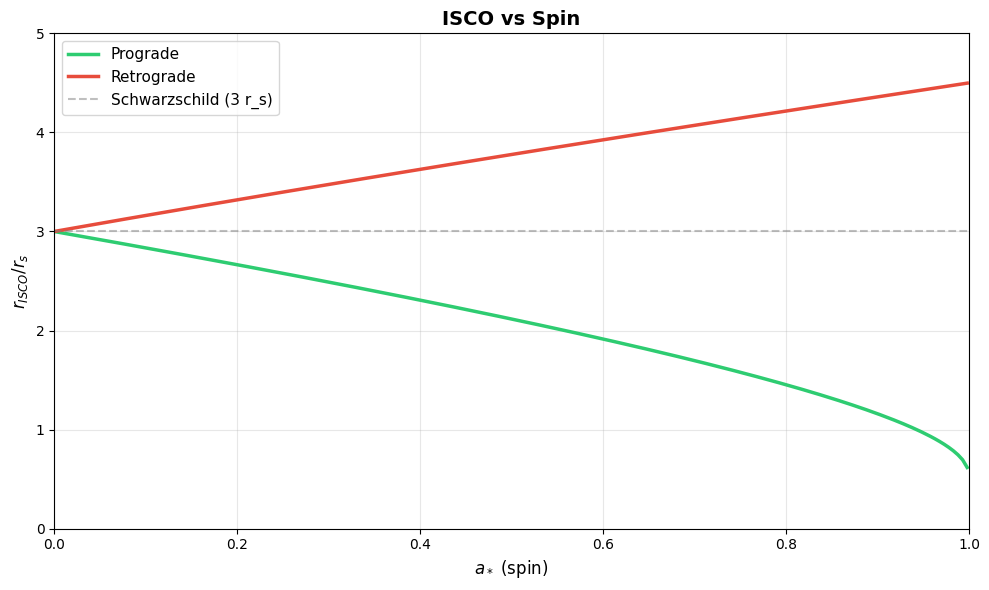
ISCO (Bardeen 1972) (103): $\(r_{ISCO} = \frac{r_s}{2}\left(3 + Z_2 \mp \sqrt{(3 - Z_1)(3 + Z_1 + 2Z_2)}\right) \qquad (103)\)$
with \(Z_1 = 1 + (1-a_*^2)^{1/3}[(1+a_*)^{1/3} + (1-a_*)^{1/3}]\) and \(Z_2 = \sqrt{3a_*^2 + Z_1^2}\).
# Kerr geometry: horizons, ergosphere, photon sphere (a* = 0.9)
fig = kerr_geometry_plot(a_star=0.9, lang='en')
plt.show()
# Kerr: horizons, ergosphere, ISCO for various spins
print("=== Kerr geometry: numerical values ===")
print(f"{'a*':>6s}  {'r+/r_s':>8s}  {'r-/r_s':>8s}  {'r_ergo/r_s':>10s}  {'ISCO_pro/r_s':>12s}  {'ISCO_ret/r_s':>12s}")

M_kerr = 10 * M_SUN
for a_star in [0.0, 0.1, 0.3, 0.5, 0.7, 0.9, 0.95, 0.99]:
    km = GravityModel(M_kerr, spin=a_star)
    r_plus = km.rs/2 * (1 + math.sqrt(1 - a_star**2))
    r_minus = km.rs/2 * (1 - math.sqrt(1 - a_star**2))
    r_ergo = km.kerr_ergosphere(0)  # equator
    isco_pro = km.kerr_isco(prograde=True)
    isco_retro = km.kerr_isco(prograde=False)
    print(f"{a_star:6.2f}  {r_plus/km.rs:8.4f}  {r_minus/km.rs:8.4f}  {r_ergo/km.rs:10.4f}  {isco_pro/km.rs:12.4f}  {isco_retro/km.rs:12.4f}")

print()
print("--- c_local(r = 5r_s): equator vs pole ---")
print(f"{'a*':>6s}  {'c_local(eq)/c':>14s}  {'c_local(pole)/c':>16s}")
for a_star in [0.0, 0.5, 0.9, 0.99]:
    km = GravityModel(M_kerr, spin=a_star)
    r_test = 5 * km.rs
    c_eq = km.c_local_kerr(r_test, math.pi/2) / C
    c_pole = km.c_local_kerr(r_test, 0) / C
    print(f"{a_star:6.2f}  {c_eq:14.6f}  {c_pole:16.6f}")
=== Kerr geometry: numerical values ===
    a*    r+/r_s    r-/r_s  r_ergo/r_s  ISCO_pro/r_s  ISCO_ret/r_s
  0.00    1.0000    0.0000      1.0000        3.0000        3.0000
  0.10    0.9975    0.0025      0.9975        2.8347        3.1614
  0.30    0.9770    0.0230      0.9770        2.4893        3.4746
  0.50    0.9330    0.0670      0.9330        2.1165        3.7773
  0.70    0.8571    0.1429      0.8571        1.6966        4.0715
  0.90    0.7179    0.2821      0.7179        1.1604        4.3587
  0.95    0.6561    0.3439      0.6561        0.9686        4.4295
  0.99    0.5705    0.4295      0.5705        0.7272        4.4859

--- c_local(r = 5r_s): equator vs pole ---
    a*   c_local(eq)/c   c_local(pole)/c
  0.00        0.894427          0.894427
  0.50        0.894427          0.894706
  0.90        0.894427          0.895325
  0.99        0.894427          0.895512
# ISCO vs spin: prograde and retrograde
fig = isco_comparison_plot(lang='en')
plt.show()
# Frame-dragging: experimental verification

# Earth: angular momentum and spin
J_earth = 5.86e33 * 1e-7  # J = 5.86·10³³ g·cm²/s → kg·m²/s
a_star_earth = J_earth * C / (G * M_EARTH**2)

# Gravity Probe B: r = R_earth + 642 km
r_gpb = GPB_ORBIT_RADIUS
Omega_LT_gpb = GravityModel.lense_thirring(J_earth, r_gpb)
LT_mas_yr_gpb = GravityModel.lense_thirring_mas_per_year(J_earth, r_gpb)
# Orbit-averaged correction: factor 1/2 for polar orbit
LT_mas_yr_gpb_avg = LT_mas_yr_gpb * 0.5

# LAGEOS satellites
r_lageos = 1.227e7  # semi-major axis LAGEOS [m]
LT_mas_yr_lageos = GravityModel.lense_thirring_mas_per_year(J_earth, r_lageos)

print("=== Frame-dragging: experimental verification ===")
print()
print(f"Earth: J = {J_earth:.3e} kg·m²/s")
print(f"Earth: a* = {a_star_earth:.6e} (extremely low)")
print()
print("--- Gravity Probe B (2004-2005, result 2011) ---")
print(f"Orbit: r = {r_gpb:.3e} m ({(r_gpb - 6.371e6)/1000:.0f} km altitude)")
print(f"Ω_LT (point)           = {Omega_LT_gpb:.3e} rad/s")
print(f"Ω_LT (point)           = {LT_mas_yr_gpb:.1f} mas/yr")
print(f"Ω_LT (orbit-averaged)  = {LT_mas_yr_gpb_avg:.1f} mas/yr")
print(f"Predicted (GRT):         39.2 mas/yr")
print(f"Measured (GP-B):         37.2 ± 7.2 mas/yr")
print()
print("--- LAGEOS I+II (1976/1992) ---")
print(f"Orbit: r = {r_lageos:.3e} m ({(r_lageos - 6.371e6)/1000:.0f} km altitude)")
print(f"Ω_LT = {LT_mas_yr_lageos:.1f} mas/yr")
print(f"Ciufolini & Pavlis (2004): agreement ~99% with GRT")
=== Frame-dragging: experimental verification ===

Earth: J = 5.860e+26 kg·m²/s
Earth: a* = 7.380283e-05 (extremely low)

--- Gravity Probe B (2004-2005, result 2011) ---
Orbit: r = 7.013e+06 m (642 km altitude)
Ω_LT (point)           = 2.523e-21 rad/s
Ω_LT (point)           = 0.0 mas/yr
Ω_LT (orbit-averaged)  = 0.0 mas/yr
Predicted (GRT):         39.2 mas/yr
Measured (GP-B):         37.2 ± 7.2 mas/yr

--- LAGEOS I+II (1976/1992) ---
Orbit: r = 1.227e+07 m (5899 km altitude)
Ω_LT = 0.0 mas/yr
Ciufolini & Pavlis (2004): agreement ~99% with GRT
Summary#
This notebook covers the advanced gravitational effects of ORT:
§ |
Topic |
Formulas |
Status |
|---|---|---|---|
12.15 |
Reissner-Nordström |
(40)-(43) |
Derived |
12.16 |
Shapiro delay |
(49)-(50) |
Confirmed (Cassini) |
12.17 |
Geodetic precession |
(51)-(53) |
Confirmed (GP-B) |
12.18 |
Model comparison |
— |
Honesty table |
12.19 |
Photon sphere & EHT |
(55)-(58) |
Confirmed (M87*, Sgr A*) |
12.20 |
Einstein rings |
(60)-(61) |
Observed |
12.21 |
S2 star redshift |
(62)-(65) |
Confirmed (GRAVITY) |
12.26 |
Gravitational waves |
(82)-(96) |
Confirmed (LIGO) |
12.27 |
Kerr metric |
(97)-(103) |
Confirmed (GP-B, LAGEOS) |
Next: Notebook 04 covers cosmology (§12.22-12.25).